
Support for session organisers

Table of Contents
- Notification letters to authors
- Preliminary scheduling
- Detailed instructions for sessions involving poster presentations
- Poster session allocations
- How do I accept abstracts in the system?
- How many abstracts can I accept?
- You can not accept an abstract as “Oral or Poster”
- What does the option “Short oral by poster” mean?
- Accept an abstract as “Poster only”
- Can I accept an “Oral only” as a poster presentation?
- Move abstracts to another session
- Instructions for the review process
- Add a review user to your session
Notification letter to authors
To access the notification letters authors will receive, kindly click the links below. These notifications were sent out on Monday, October 30, 2023.
Short oral by poster presentation
Here’s a brief overview of what to expect as we move forward with the process:
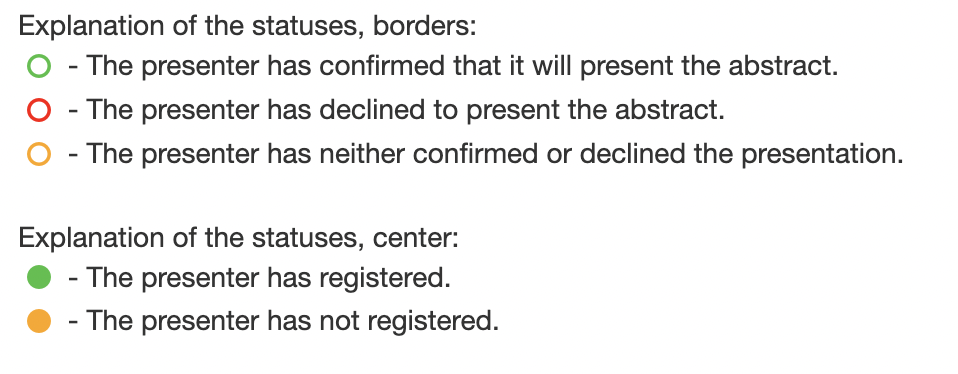
- In the notification letter, presenters will be able to confirm their presentations. To track the status of each abstract, please visit the “Scheduling” tab in your account. Information about the presenter registration status can also be found there. To understand the meaning of each status, please see the image below.
- If a presenter declines their presentation, you’ll have the option to upgrade another abstract. For example, if a short oral presenter declines, you can upgrade an accepted poster without a presentation to be included in the poster session.
- We’ll provide you with further details about the schedule before we publish the program. The program is set to launch in January.
Preliminary scheduling
As the session accepter, you will be in charge of arranging your own session within the abstract system. We have added a new option that allows you to schedule it directly from your account. You won’t receive the exact date of your session just yet; it will be communicated to you at a later time. Please ensure all your accepted abstracts are scheduled by October 4, 2023. Here’s what you need to do:
- Click on this link to access your account.
- Log in using the same credentials as when you reviewed and accepted your abstracts.
- Click on “Scheduling” in the menu to the left.
- On the right side, you will find your session(s), and on the left, you will see the accepted abstracts. Note that each abstract needs to be given an acceptance status first before they show up on this page (read more here).
- To schedule an abstract, simply drag and drop it using the provided function, watch here.
- Important Note: Please don’t alter the session titles on the schedule.
- Please also enter a maximum of two chairs for each session, including any poster sessions. Click on this link for a quick video tutorial on how to do it. Please note that the chairs for your session(s) must be registered for the conference.
Schedule the main session
The main session’s organization and structure are entirely up to you as the session organizer, read more here. All the abstracts included in your main session should be accepted as “Oral only”. Abstracts accepted as “Short oral by poster” or “Poster only” should not be scheduled in the main session. Please double-check to ensure that this is not the case in your session.
- You are not allowed to accept/schedule abstracts with the presentation format “Oral or Poster”. If you have already accepted abstracts as “Oral or Poster”, you need to update the status of those abstracts to one of the available accepting options here.
Schedule poster sessions – 9 abstracts per session
Please take note that if your session has been allocated poster session(s), each poster session slot can accommodate a total of 9 abstracts. It’s not acceptable to accept more or fewer abstracts for each poster session. This rule also applies to scheduling abstracts for the poster sessions, where every program slot should include exactly 9 scheduled abstracts.
The poster session allocation list only includes sessions that requested extra poster sessions outside the oral session and had enough abstracts. If your session isn’t listed here, it’s because it did not fulfill these conditions, and you are not allowed to accept and schedule abstracts in the “Short oral by poster” format.
“Poster only” abstracts should not be included in the schedule
The abstracts that are accepted as ‘Poster only’, will not be included in the schedule and there’s no need to allocate time slots for them. Their poster will only be displayed at the conference for everyone to read.
Detailed instructions for sessions involving poster presentations
For sessions that allow poster presentations, these presentations may be given orally at E-poster stands during the poster sessions. Poster sessions are expected to take place during the 2-hour lunch breaks. The 2-hour lunch breaks will be split into two 1-hour poster sessions, comprised of 45 minutes of presentations, followed by 15 minutes for informal discussions within your session as well as technical preparations for the subsequent sessions.
A poster presenter within a session is invited to give a 3-minute presentation, followed by 2 minutes of questions (led by your assigned poster session moderator), meaning a total of 5 minutes per presentation and a maximum of 9 posters during each 45-minute session. For example, if your session is allocated 4 poster sessions in the program, you will have the opportunity to accept a total of 36 short oral poster presentations. We have a set number of allowed abstracts per poster session slot that needs to be followed, so it is essential to accept exactly 9 abstracts as ‘Short oral by poster’ per slot. Poster sessions will be given at E-poster stands that are located outside of the rooms of oral presentation, in a dedicated area for all E-poster stands.
The above means that poster sessions will be given at a separate time and place from the oral presentations of the technical session or sub-plenary. As an example, a technical session might take place on Monday afternoon, and then the extended poster session might take place during the lunch break on Tuesday. You could have different moderators for the oral and poster sessions.
Poster session allocations
This list only includes sessions that requested extra poster sessions outside the oral session and had enough abstracts. If your session is not listed here, it is because it did not fulfill these conditions.
In the table below, you will find the precise allocation of poster session slots assigned to your session. The allocation of poster slots was determined based on the number of abstract submissions for each session. In column three of the table, you can see the maximum number of abstracts you can accept for the ‘Short oral by poster’ format. Each poster session slot can accommodate 9 abstracts – Please keep in mind that it’s not possible to accept more or fewer abstracts for each poster session. For example, if your session has been allocated 3 poster sessions in the program, you need to accept a total of 27 abstracts as ‘Short oral by poster’.
| Session titles | # of poster sessions | # of abstracts as "Short oral by poster" |
|---|---|---|
| S1.1 Close-to-nature silviculture for global change adaptation and mitigation | 5 | 45 |
| S1.2 Forest health under climate change and air pollution | 6 | 54 |
| S1.3 Forests in a changing world – impacts on carbon and nutrient dynamics | 8 | 72 |
| S1.4 Global water provision: Understanding the forest-soil-water nexus under forest management, climate change and increasing disturbances | 4 | 36 |
| S2.1 Governance of a Bio-resource-based Bioeconomy in the Global South | 2 | 18 |
| S2.2 Smart Forestry – Transforming Forestry and the Future Forest Workforce | 2 | 18 |
| S2.4 Unlocking the bioeconomy for nontimber forest products | 1 | 9 |
| S3.1 Assisted migration for adapting forests to climate change | 3 | 27 |
| S3.2 Restoring forests and trees: Balancing goals, interests and trade-offs | 2 | 18 |
| S4.1 Building international initiatives to strengthen forest adaptation strategies in a changing climate | 1 | 9 |
| S4.4 Socio-ecological conflicts in forest management: risks of (not) adapting? | 4 | 36 |
| S5.3 How to incorporate indigenous and local knowledge in forest education, back to the roots | 1 | 9 |
| S5.4 In practice of a gender equal and inclusive forestry sector | 1 | 9 |
| S5.5 Integration of gender and diversity perspectives in knowledge production | 1 | 9 |
| S5.6 Transforming and restoring forests for more resilient landscapes and societies – towards the IUFRO Stockholm declaration | 1 | 9 |
| T1.1 Biology, ecology and management of pest and pathogen invasions in forests: a global perspective. | 6 | 54 |
| T1.2 Carbon sinks in forest soils as controlled by fine-root dynamics | 1 | 9 |
| T1.3 Challenges for silviculture to meet demands from carbon sequestration to biodiversity conservation to forest restoration | 1 | 9 |
| T1.4 Climate Smart Forestry | 3 | 27 |
| T1.5 Climate-smart pine forest management | 1 | 9 |
| T1.6 Coastal Blue Forests: Global Significance, Ecology, Management and Conservation | 2 | 18 |
| T1.8 Complex forests: Understanding and management of multiple species, structures and ecosystem services. | 6 | 54 |
| T1.9 Dendroecology for Evidence- based solutions and Resilient Forest landscapes | 2 | 18 |
| T1.10 Enhancing forest resilience for water-related ecosystem services in a changing environment | 2 | 18 |
| T1.11 Forest Fires in Mountain Regions | 2 | 18 |
| T1.12 Forest genetics tools to improve forest resilience to climate change and forest health | 5 | 45 |
| T1.13 Forest management for climate change mitigation | 4 | 36 |
| T1.14 Forest radioactive contamination: long-term dynamics and impact on ecosystem and society | 1 | 9 |
| T1.15 Impacts of Global Change on Protective Forests in Mountain Areas | 1 | 9 |
| T1.16 Implementing fire-resilient landscapes | 3 | 27 |
| T1.17 Learning from the past to better inform the future: integrated approaches to increase forest health and resilience | 2 | 18 |
| T1.18 Long-term experiments to study the effects of silvicultural interventions and climate change on forest dynamics | 1 | 9 |
| T1.19 Managing Forests for of Multiple Ecosystem Services under Changing Climate | 3 | 27 |
| T1.20 Needle diseases of conifers: a globally rising threat to natural and planted forests | 1 | 9 |
| T1.23 Nitrogen Depositions in a changing climate: Trends and Implications on Forest Ecosystem Services | 1 | 9 |
| T1.24 Old-growth forest ecology and management | 1 | 9 |
| T1.27 Response of forest ecosystems to global change: Learning from experimental manipulations and natural gradient studies | 4 | 36 |
| T1.30 Securing multiple ecosystem services from mountain forests | 1 | 9 |
| T1.31 Silviculture of boreal forests in the face of climate change | 1 | 9 |
| T1.33 The Pine Wilt Disease dramatic impact on conifers forest across the world, today and in the future | 1 | 9 |
| T2.1 Accounting for risks and uncertainties in forest-based businesses, sectoral projections, and policy design | 1 | 9 |
| T2.3 Contribution of wood-based products to climate change mitigation: State-of-the-art and research directions | 2 | 18 |
| T2.8 Fast-Growing Trees for a Greener Future: Global Applications of Nature-Based Solutions | 2 | 18 |
| T2.9 Forest to Food: Developing synergies across forest restoration, the bioeconomy and sustainable agriculture | 1 | 9 |
| T2.11 Forest-based sector in sustainability transformation: opportunities and sectoral impacts | 1 | 9 |
| T2.14 Innovations and new business models towards more sustainable circular forest bio-economy, especially including life-cycle and techno-economic assessments | 2 | 18 |
| T2.15 Innovations to support sustainability in non-timber forest products value chains | 1 | 9 |
| T2.16 Innovative technologies for the development of bamboo and rattan products | 1 | 9 |
| T2.17 Local ecological knowledge of non-wood forest products for sustainable forest management and human well-being in diverse contexts | 1 | 9 |
| T2.18 Mixed forest plantations as natured-based solutions for climate change mitigation and adaptation | 1 | 9 |
| T2.19 Non-timber forest products and the bioeconomy | 2 | 18 |
| T2.21 Pathways towards sustainable and circular forest-based bioeconomies: Advances in research to address challenges and realize opportunities | 3 | 27 |
| T2.23 Planted Forests for Achieving a Sustainable Planet | 1 | 9 |
| T2.26 Silviculture for the Bioeconomy and Ecosystem Services in Castanea Forests | 1 | 9 |
| T2.27 SMART (Sustainable Modern Acceptable Resilient Technological) Agroforestry Practices for Sustainable Livelihood and healthy environment | 4 | 36 |
| T2.29 Strengthening Teak Forest Management for Sustainable Teakwood Supply Chains and Trade | 1 | 9 |
| T2.30 Sustainable Forest Operations (SFO): Challenges and opportunities towards a resilient wood supply chain and worker's well-being | 1 | 9 |
| T2.32 Traditional knowledge, geographical indications and non-timber forest products towards a bioeconomy in community-based agroforestry systems | 1 | 9 |
| T2.34 Tropical Peatland Forest Conservation and Sustainability: Challenges and Opportunities | 2 | 18 |
| T2.35 Wood durability and wood protection strategies for long-term carbon storage of wood products | 1 | 9 |
| T3.1 Advances towards more accurate forest biodiversity indicators and monitoring | 2 | 18 |
| T3.3 Disappearing oak woods: conservation and management of global oak forests | 2 | 18 |
| T3.4 Ecological and socioeconomic analysis of invasive species in forest ecosystems under changing environmental scenario | 1 | 9 |
| T3.7 Forest biodiversity indicators: supporting our response to the biodiversity and climate emergencies | 2 | 18 |
| T3.8 Forest genomics as a vantage point to biodiversity and adaptation under global change | 2 | 18 |
| T3.9 Forest landscape restoration (FLR) and SDG Goals from the lens of forest policy and governance | 1 | 9 |
| T3.10 Forest management solutions under global change: connections between tree breeding, intensive silviculture and wood quality | 1 | 9 |
| T3.11 Forest resilience: the vision from belowground | 2 | 18 |
| T3.12 Forest Restoration Success and How to Achieve it | 3 | 27 |
| T3.13 Forest restoration under climate change in Southeast Asia: innovative tools, model, and approaches | 1 | 9 |
| T3.14 Forest Tree Breeding in the Context of Climate Change and Bioeconomy Development | 2 | 18 |
| T3.15 Forest Wetlands as Nature Based Solutions for Water, Biodiversity and Climate | 1 | 9 |
| T3.17 Genomics of Keystone and Underused Forest Genetic Resources for Their Climate Adaptation, Resilience, Conservation and Sustainable Management | 2 | 18 |
| T3.19 Increasing the potential of natural regeneration in restoring degraded forest and deforested lands around the world: concepts, strategies, experiences and guidelines | 2 | 18 |
| T3.20 integrated forest management in temperate and boreal forests - balancing biodiversity and ecosystem services | 2 | 18 |
| T3.21 Legacy tropical forest data: current status, uses, and securing them | 1 | 9 |
| T3.22 Managing forest genetic resources for multi-purposes for forest products, ecosystem services and response to climate change | 1 | 9 |
| T3.23 Mini-Symposium: Resilience of Forest Biodiversity to Climate Change and Pests: Civic Engagement and Conservation in Seed Banks, Public Gardens, and Wild, Urban, and Agroforestry Landscapes | 1 | 9 |
| T3.24 Minimizing forestry impacts on water quality, aquatic biodiversity and ecosystem functions | 1 | 9 |
| T3.28 Opportunities to promote biodiversity recovery and protection through innovative forest management approaches | 1 | 9 |
| T3.29 Reforestation Under Drought Conditions | 1 | 9 |
| T3.32 The scientific basis for how to safeguard biodiversity in production forestry | 1 | 9 |
| T3.34 Tree improvement delivery system: breeding, selection, and seed and seedling production | 5 | 45 |
| T4.1 Actors and the dynamics of forest management institutions: concepts and cases in the Global South | 1 | 9 |
| T4.6 Conflicts in Forest Settings | 2 | 18 |
| T4.8 Effects and effectiveness of forest policies in developing tropical statehoods | 1 | 9 |
| T4.9 Evaluating policy outcomes in complex land-use systems | 1 | 9 |
| T4.11 Forest-based care as an innovative pathway to shifting values, uses and governance of forests | 1 | 9 |
| T4.12 Forests in Cities: Ecology, management, and silviculture. | 1 | 9 |
| T4.14 Governing EU’s forests: policy narratives, perception and power | 1 | 9 |
| T4.15 Healing Power of Nature: Forest Therapy in Action | 2 | 18 |
| T4.16 How to reconcile poverty alleviation with forest integrity in tropical dry forests: ecological research gaps and paradigm shifts for sustainable management. | 1 | 9 |
| T4.19 Institutional and Social Innovations in the Forest-based Sector as a Response to Contemporary Challenges | 2 | 18 |
| T4.20 Managing Safety and Resilience of Forests and Forestry affected by Armed Conflicts and the Climate Crisis: Past and Future Contribution of Forest Science | 1 | 9 |
| T4.23 Preserving and improving the integrity and functioning of urban forests in the context of global change | 1 | 9 |
| T4.24 Provision of Ecosystem Services from Small-scale Private Forests - Is it viable? | 1 | 9 |
| T4.27 Small-scale, Community, and Indigenous Forestry: Global Challenges and Opportunities | 2 | 18 |
| T4.30 Urban green against air pollution and climate change | 1 | 9 |
| T4.31 Urban trees & green landscapes: Monitoring and management for providing multiple services | 5 | 45 |
| T4.34 Work and employment in the forest sector: challenges and opportunities | 1 | 9 |
| T5.1 Artificial Intelligence in Forest Biometry: from predictions to understanding | 1 | 9 |
| T5.8 Developments in complex remote sensing-assisted forest surveys to support monitoring and assessment of forest ecosystems | 3 | 27 |
| T5.9 Digital (soil) mapping as a suitable approach to generate spatial forest site and biodiversity data at different scales | 1 | 9 |
| T5.10 Digitalization for sustainable forest management | 3 | 27 |
| T5.13 Forest without borders: National Forest Inventory Networks and their potential for large scale monitoring and reporting | 1 | 9 |
| T5.14 Gender Equality in Forestry: Past, Present and Future | 1 | 9 |
| T5.16 IAWA-IUFRO Symposium: Advancing Methods and Applications of Wood Identification | 1 | 9 |
| T5.20 Innovation in valuation and governing of forest ecosystem services to strengthen forest resilience and create pathways to societal impacts | 2 | 18 |
| T5.22 Modelling forest trajectories under climate stress and changing management | 3 | 27 |
| T5.23 Monitoring patterns and processes in natural forests to assess their contribution to climate-change mitigation | 4 | 36 |
| T5.24 Moving towards digital forests for a sustainable future | 2 | 18 |
| T5.26 New solutions for challenges in decision support for mitigating disturbances to increase forest health and resilience under climate change | 1 | 9 |
| T5.30 Simulation and automation in modern forest operations | 1 | 9 |
| T5.33 Temporal, spatial and big data - Challenges for modelling climate change impacts on forest tree and stand growth | 1 | 9 |
| T5.34 The new age of forest monitoring: A common European forest monitoring system in a global perspective | 1 | 9 |
| T5.35 The next generation of forest decision support systems for tackling today’s and future challenges! | 1 | 9 |
How do I accept abstracts in the system?
As the session accepter, you will have access to the “Accept” section when you log in to your review account. It is located right alongside the Review section, below the abstract text. There, you will find a summary of all the completed reviews, along with the initials of the reviewers. This is also where you will set the acceptance status. You have the option to choose whether an abstract should be accepted as:
- Oral only
- Short oral by poster [part of a poster session]
- Poster only [exists only as a poster and not presented in orally]
- Rejected [rejected for IUFRO 2024]
When you have made your decision, you need to click on “Save accept”. Please keep in mind that you can modify this decision later on, and the authors will not receive automated notifications about their acceptance status at this stage. The authors will be informed by us if their presentation is accepted by 30 October 2023.
How many abstracts can I accept?
As session organizer you will be able to determine the order and length of each presentation depending on your needs, however, we recommend 15 minutes per presentation or down to 3-5 minutes for flash talks. If you have a technical session you have a total duration of 120 minutes to allocate for both oral presentations and flash talks and for a sub-plenary session you will have 60 minutes. By following our recommendations, you can accept approximately 10-12 oral presentations for a technical session and 4-5 oral presentations for a sub-plenary session.
It is not possible to extend the time limit of your session to accommodate additional talks. These are the following options available:
- Reduce the length of oral presentations
- Accept some abstracts as “Short oral by poster”, read more here.
- Move some abstracts to another session or the potpourri session , read more here. (This is no longer possible)
- Accept as “Poster only” – You’re asked to be generous with the acceptance of Posters (if not Oral or Short Oral by Poster), and only fully reject abstracts if far outside the area/topic of IUFRO 2024, read more here.
You cannot accept an abstract as "Oral or Poster"
When submitting an abstract, the option “Oral or Poster” are used to indicate the presenter’s preferred presentation format if their abstract is accepted. It does not mean that you can choose to accept their abstract as both oral and poster presentations.
You will determine whether it should be accepted as:
- Oral only
- Short oral by poster [part of a poster session]
- Poster only [exists only as a poster and not presented orally]
- Rejected [rejected for IUFRO 2024]
If you have already accepted abstracts as “Oral or Poster”, you need to update the status of those abstracts to one of the available accepting options above.
What does the option "Short oral by poster" mean?
By selecting the “Short oral by poster” option when accepting an abstract, you are giving the presenting author the opportunity to present a poster during the dedicated poster sessions. These sessions will be scheduled separately and are expected to occur during the 2-hour lunch breaks and the poster presenter will be expected to give a 3-minute presentation, followed by 2 minutes of questions.
Accept an abstract as "Poster only"
If you choose to accept an abstract as “Poster only,” it means that the author will not be allocated an oral presentation or a short oral by poster. Their poster will only be displayed at the conference for everyone to read, so these abstracts will not be included in the schedule and there’s no need to allocate time slots for them.
Can I accept an "Oral only" as a poster presentation?
Abstracts submitted as preferred presentations “Oral only” during the submission process may also be accepted as a poster presentation. However, in the notification letter, authors will have the option to confirm their accepted presentation format. If they decline, it means they only wanted to be accepted for an oral presentation and do not wish to present a poster.
Move abstracts to another session
The option “Move to other category” is now available. If you believe that the submitted abstract is not suitable for the current session it was initially intended for, and you would like it to be considered for another session or the potpourri session, please follow the simple process below.
- Complete a review of the abstract, providing your assessment and feedback. Please leave a comment in the comment section indicating the proposed change, such as: “This abstract was originally submitted for session XYZ, but I think it would be a better fit for session XYZ”
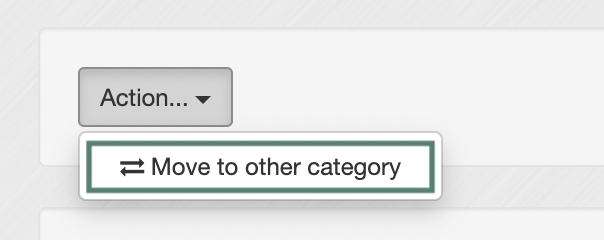
- After saving your review, locate the “Action” button and click on “Move to other category” (see pictures below).
- Please select the session to which you would like the abstract to be moved. If you would like the abstract to be moved to the “The Scientific Committee – Potpourri session” session, please choose the first option in the drop-down list.
- Please note that this option will not be available after August 31.
Please click on this link to access the List of Sessions.
The Scientific Committee – Potpourri session Once your request is submitted, the scientific committee will carefully evaluate the results of your review and make a decision regarding the abstract’s potential transfer or rejection. 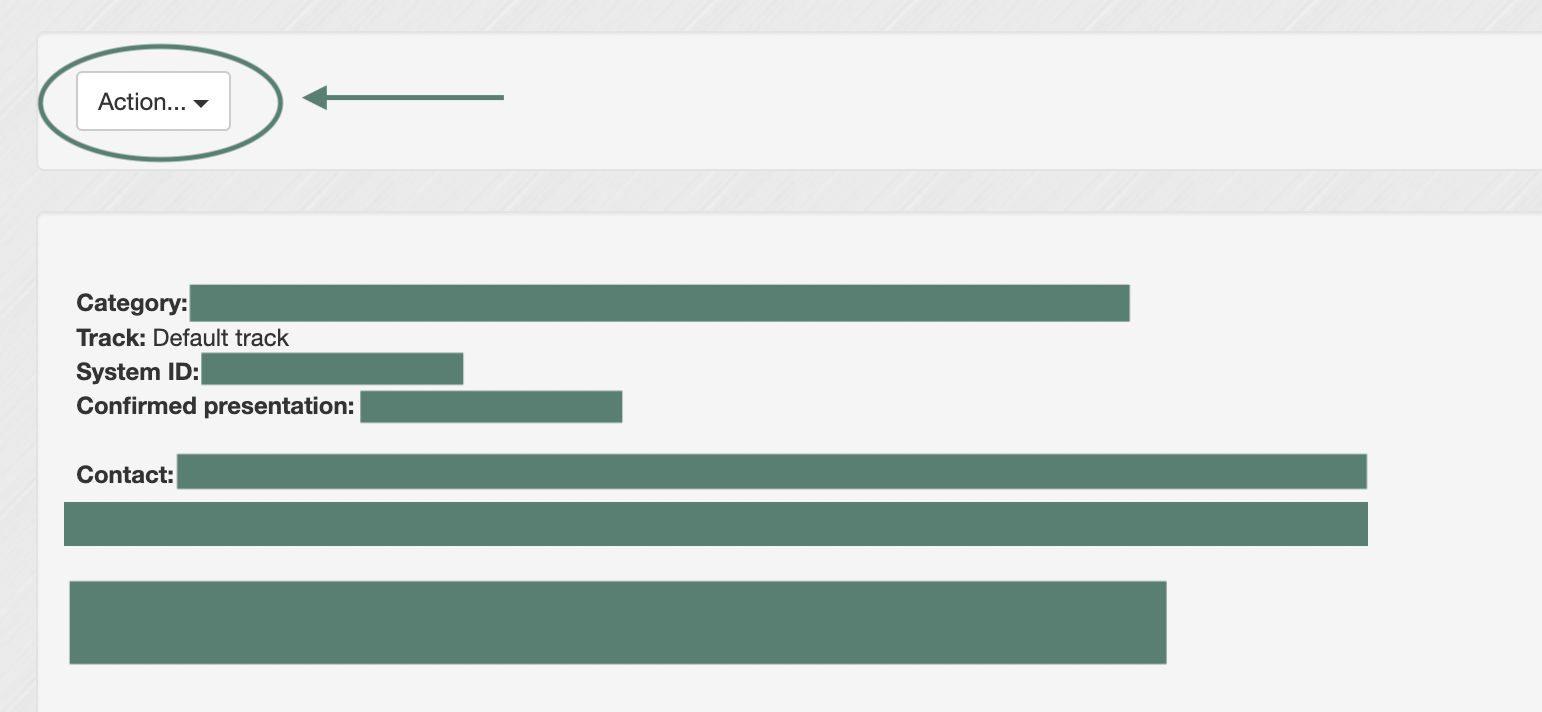
 Please note that in the system, the term “Category” refers to “Session.
Instructions for the review form
All session organizers should have received multiple emails containing their review account login credentials. These credentials will grant you access to the abstracts that have been submitted for your session(s). To access your review account click on this link. The deadline for the review process is extended until August 31, 2023. This means that all reviews should be completed by that date. Once logged in you can follow the below process:
- You will find all assigned abstracts in the list on the Review page.
- Click an abstract title in the list and the full abstract text will be loaded on the right.
- Read the abstract and then complete the Review section below the text and click “Save review”.
- Repeat the steps above for each abstract.
Add a review user to your session
You can add more review users yourself. You need to click on the button User and when creating a user, remember to always select the person’s email address as Username, click on the session, and Type: Reviewer. After creating a user, mark the person you want to send the invitation to and click on Send invitations to checked.
If the individual in question is already a review user for another session, we need to help you by adding your session to their existing account. Please reach out to us at abstracts.iufro2024@appinconf.com and provide us with the names and email addresses of the individuals you would like us to add as reviewers for your session.